Pages

Showing posts with label Mattamuskeet. Show all posts

Wildlife at Mattamuskeet

I have some information and photos of Jump Off Rock in Henversonville to pass along, but couldn't wait to share a few photos from our recent trip to Lake Mattamuskeet (the big hole in the flap of land along the NC coast.)


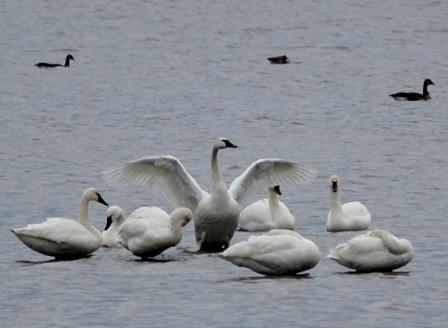
It's December, which means Tundra Swans, Snow and Canada geese, and thousands of other migrating waterfowl have stopped by the state to rest a spell before moving southward. Many of the birds were near the shore, so we had some great views. It's a long drive, but well worth the visit.


Panoramic shot of the cypress islands at Mattamuskeet:


The Return of the Swans

Sorry, but after reading @ (Swanquarter, Hyde Co, etc) recent Twitter tweet, I couldn't resist...

The snowy swan arched her wings and rising up, took flight. And soared across the tundra ice in search of warmer nights. Though weary from the journey of a thousand miles or more, she pressed on southward to her goal on Carolina shores.


At last! The oval lake of blue appeared within her sight. The snow swan then arched her wings and ended there her flight.


Landing in the shallow waters, she at a cypress moored.

And there she rested for a month on Carolina shores.


According to Inner Bank's tweet, the swans are back around Swanquarter and Lake Mattamuskeet. We'll be heading east in the near future!

A Final Look at Mattamuskeet

Okay, okay, okay, I know I've done the waterfowl thing to death, but the birds are amazing. And, when it's cold outside, one can view wildlife at Mattamuskeet from inside the warmth of the car—and it's been cold!

For that reason, we took one more trip to the amazing Lake Mattamuskeet before the 09-10 wintering waterfowl season ended. No snow geese (no surprise ) but we saw much as we drove along Hwy 94. Enjoy.


From Pungo to Mattamuskeet: Chasing Waterfowl of the Pocosins

It's November (though we're still trying to figure out how), which means the Pocosin lakes on the Albemarle-Pamlico peninsula will soon be filled with thousands of mergansers, wood ducks, Tundra swans, and at least three snow geese.

Eager to see the symphony of flight, we traveled to Pungo Lake to see what was out there. Unfortunately, as with our last visit, the south entrance at Hyde Park Road was blocked off. More unfortunately, the road running perpendicular was also barricaded. More on that later.

There was no sense turning around until we met our objective, so we set the GPS to Lake Mattamuskeet and headed east...and didn't see a single duck. Not one. Nor did we see any swans or the feather of a snow goose. But Mattamuskeet being Mattamuskeet, there was still beauty to be found in her waters and along her shores, including a doe that seemed as curious about us as we were of her:

Because we intend to return to Pungo next month, I called the Pocosin National Wildlife Refuge to ask about the road closures. The admin connected me to the refuge's botanist (Botanist? Goodness, I could have kept her on the phone all day) who informed me the entrance at Hyde Park Road is always blocked. Worse, the dirt road that runs perpendicular is a private road, so we're not at liberty to use it to travel around the refuge.

The botanist, Wendy, I believe, did inform me the observation platform on the south side of Pungo can be reached by turning on Pat's Road from Hwy 45, then right on the first dirt road and left on Hyde Park Canal (north of the barricade). Take a good map or GPS—and four wheel drive—if you attempt this route.

Wendy also mentioned she spotted thirty Tundra swans that morning. Finally! More are sure to follow in the near future. That alone thrilled me, but then she mentioned she planned on taking an aerial survey of the surrounding fields to see if other birds had slipped in unnotice.

Aerial survey? I wonder if they need someone to tag along to take photos....

Image of the Day: Fishing at Mattamuskeet

We recently made a quick trip to Lake Mattamuskeet (or as I called it that day, Lake ManyMosquitoes) to check out the goings on. All seemed quiet, but in a few months, thousands of ducks and swans and two or three snow geese will descend on the pocosin lakes in this region. Until then, Lake Mattamuskeet seems to be the place to while away the lingering summer hours:


--------------------------
Copyright 2009. All Rights Reserved. Do Not Copy or Distribute

Snow and an Eastern NC Sunset

Eastern NC had a treat last week when two to several inches of snow fell on us, turning fallow fields into thick, white blankets, and blackwater swamps into winter wonderlands. I'm told the snow fell as far as Nags Head on the Outer Banks.

We ventured out a bit, but like all good southerners should, we didn't travel far on the unfamiliar slick stuff. And of course, I took pictures. So for the record, here are images of eastern NC during a snow storm:


Apparently not fully content with that treat, we traveled back to NC's largest Pocosin on Friday to see if those snow geese finally arrived (after all, the snow had.) They haven't, and I've reached the conclusion they're not coming en masse this year. Though disappointed--again--we did witness another spectacular Mattamuskeet sunset. That alone was worth the drive:


Don't you agree?

NC's Natural Communities, Part II: Lake Mattamuskeet

According to the University of North Carolina's, Documenting the South, John Lawson arrived near Bath, NC on February 24, 1701.1 Shortly after, he built a home near modern day New Bern. Since Mr. Lawson intended to survey the Carolinas, I can only believe he found his way to Lake Mattamuskeet, located just northeast of New Bern, across the Pamlico Sound. In his journal, A New Voyage to Carolina, he makes a reference to "(swans) which come in great Flocks in the Winter".2

It must have been a sight to behold. It is today. This past spring, a member of my hiking group mentioned the snow geese swirling over Mattamuskeet at sunrise and since then, I haven't been able to get that mesmerizing image out of my mind. Eastern NC CarolinasAdventurers discussed a January outing, but I couldn't wait. A week after visiting Green Swamp, my husband and I were standing on the shores of North Carolina's largest natural lake.


Over five miles wide, like Phelps and Pungo (also located on the Albemarle-Pamlico Peninsula) Lake Mattamuskeet is shallow, on average, just two feet deep.3 According to exploring north carolina's natural areas, it's also the largest Pocosin lake in the southeast United States.4 If you've seen a map of North Carolina, you've seen this lake—it looks like a hole punched out in the bottom of the raggedy middle flap of NC's coast.

Finding Mattamuskeet wasn't hard. We traveled east on Hwy 264 until we reached Hwy 94, then we turned left. Thankfully (for us, not the birds) this highway slices north-south through the center of the lake. We parked on a grassy shoulder a mile down the road and were promptly blown away. Hundreds of brown ducks that we mistook as broken wood or the bases of trees drifted in the shallow water near the shore. Shortly after, they took flight.


Beauty makes me weep, and the sight of that large flock flowing gracefully through the sky before us nearly brought me to tears. Only the unequivocal joy surging through me as I watched them and several herons lounging nearby kept the brine at bay.

Fifty-two pictures later, we resumed our journey, and for the next hour we observed and photographed more waterfowl than I've seen at one time: Blue Herons. White Herons. Canada Geese and a long stretch of birds floating a mile down the lake captivated us. We stopped at the observation pier, located near the midpoint of the road, and watched Tundra swans floating past an island of cypress trees, its knobby knees sticking up like a bed of nails. I jerked the car off the side of the road at my husband's command when we spotted herons perched in a tree. We photographed a clutch of herons standing in still waters, their reflections as clear and defined as the birds themselves. We continued on until hunger forced us to find food. 

Mattamuskeet is a must for bird and nature enthusiast, and anyone who loves beauty. And there's more to explore than what we saw. If you view the lake through Google Earth, you can see a jetty or boardwalk jutting into the water on the east side, and several small islands on the west. We'll have another chance, though. We still have that January outing, and I wouldn't be surprised if we slipped back there in December. Wouldn't you?