In the northwest quadrant of the Great Smoky Mountains, west of the Sugarlands Visitor Center, in the Tennessee side of the park, is an anomaly. A pit in the mountains. Grassy lowlands surrounded by jagged peaks.
Members of my hiking group, CarolinasAdventures, have talked about it for years, and while I'd seen photos, I couldn't envision the valley in its entirety or understand why visitors gushed over the place. So when we started making plans to spend a few days in the mountains, I suggested the Smokies and the meadow known as Cades Cove.
According to several sources, Cherokees once hunted in this valley, and settlers moved in around 1820. Evidence of the latter still can be seen in the form of several churches atop small knolls, and empty cabins tucked in the pine and hemlock forest.
To get there, visitors travel down a sometimes treacherously narrow, winding two-lane road bordered by a river with bubbling cascades on one side, and a rock face on the other. After descending to the base of the peaks, guests pass through a gate and begin an eleven-mile journey along a one-lane loop that skirts a grassy meadow.
Though cars sometime travel bumper-to-bumper, and visitors stroll down dirt paths to hike a trail or meander around old homesteads, the cove still manages to maintain a certain serenity. Here, deer graze in close proximity to humans and turkeys hold up traffic to cross the road. Here, as I'm told, bears wander in search of food. Despite the bears, it is easy to imagine this place was once a place a peace.
In addition to a campground, several trails extend from Cades Cove. At least two of which lead to a waterfall. We visited Crooked Arm Cascade during our visit, though we were dismayed to discover the only way to get a good view of the falls is to slip down the side of a steep slope. However, with Abrams Falls nearby, and cascades located off the road to Cades Cove, there's plenty to see.
We didn't limit our explorations to sightseeing. While at the visitor center, we picked up a small field guide called Waterfalls of the Smokies, and while my husband drove, I read. From it, I learned which falls were located in which part of the park, but I also learned that the "arm" in Crooked Arms cascades doesn't refer to a limb, but to a ridge.That explained the waterfall.
More important, I learned that the floor of Cades Cove is made up of the highly-erodible limestone, which is how a grassy lowlands came to exist in the midst of a mountain chain.
Though we drove to Cades Cove twice during our time in the Smokies, we plan to return during future visits. To spend a night at the campground and explore trails on foot. As others before us have discovered, there is something special about this place. As silly as it sounds, something that touches an inner yearning.
For more information on Cades Cove, visit www.nps.gov/grsm/planyourvisit/cadescove.htm Or better yet, spend some time there. Photos and text can't do the place justice. Just don't feed the bears.
Taking on the Sinks
I'm jumping ahead in my Smokies posts because a couple of people are waiting to see these photos.
Beneath a bridge on the road to Cades Cove is a small cascades known as The Sinks. Waterfalls of the Smokies describes it as, "The Little River sinks suddenly and dramatically over tilted formations of Thunderhead sandstone." The author is referring to this view:
While we were visiting The Sinks, a couple of kayakers prepared to take on the white water. We had to see that! And of course, I had to take photos.
Unexpected fun on our last day in the Smoky Mountains. Thanks, guys!
Beneath a bridge on the road to Cades Cove is a small cascades known as The Sinks. Waterfalls of the Smokies describes it as, "The Little River sinks suddenly and dramatically over tilted formations of Thunderhead sandstone." The author is referring to this view:
While we were visiting The Sinks, a couple of kayakers prepared to take on the white water. We had to see that! And of course, I had to take photos.
Unexpected fun on our last day in the Smoky Mountains. Thanks, guys!
Labels:
kayaking,
smoky mountains,
The Sinks
A Week in the Smokies
We just returned from the Great Smoky Mountains, where we spent three days hiking, enjoying waterfalls, and taking picture after picture of the largest display of spring flowers we've seen to date. We spent time on the Roaring Fork loop and in Cades Cove, the Sinks and a waterfall behind the Sugarland Visitors Center, and I have much to share. Here's just a sample of what I'll discuss in the next few posts.
A rainy day in Cades Cove:
Trillum, trillium, and more trillium:
A little bit of wildlife:
And let's not forget the water:
More to come!
A rainy day in Cades Cove:
Trillum, trillium, and more trillium:
A little bit of wildlife:
And let's not forget the water:
More to come!
De Hart Botanical Gardens, Franklin Co, NC
Sunny with a high in the mid 80s. After a long winter, we couldn't waste a day like that indoors, so we slipped on our hiking shoes and headed outside.
But where to go?
Before we left, I'd grabbed my copy of 100 Classic Hikes in North Carolina, which I'd purchased last year and had yet to use. As my husband drove to Bojangles for my beloved iced tea, I flipped to the index and read each entry under the Coast Trails, Piedmont, and More Piedmont Trails headings. One caught my eye, and after reading the description, we were on our way to the Franklin County Nature Preserve of the De Hart Botanical Gardens.
Located on Hwy 401, about 4.7 miles north of Hwy 98 in Franklin County, the eighty-eight acre preserve is home to a rare flower and crane-fly orchids, thanks to its unique location along NC's Fall zone. Signs at the trailhead state the land is private, but open to the public provided they follow the rules. The first is to sign in at a picturesque gazebo. A gracious deal no matter how you look at it, so after signing in, we collected a map from the brochure box and headed down the first of many trails.
The park is separated into two sections. Each section has 1.8 miles of hiking trails and different, but really cool features. We started out at Section B: the Waterfall Loop.
Yes, a waterfall! After hiking over a bridge and past boulders and rock outcroppings (more on that in a minute), we made our way around a switchback and faced a small waterfall. It may have been far shorter than Looking Glass or Schoolhouse Falls, but it was still a waterfall, and it's located in eastern NC.
We continued on, taking a short sidetrail to see—according to 100 Hikes—the remnants of the old Timberlake homestead. I have no information on the family, though I'd love to know more about them. Beyond some scrap metal and a large hole in the ground, we saw only the peaceful outdoors, the beginnings of a large spread of daffodils, and two of the biggest trees we've seen outside of Congaree Swamp in South Carolina. Definitely worth the short detour, especially when the daffodils are in bloom (which they were not during our visit).
What a colorful touch to add to a farm then so far from civilization. And what a wonderful gift left behind for the rest of us.
After touring the grounds, we picked up the original trail, at times following a creek, once passing a pond, until we looped back to the the trailhead. From there, we crossed the parking lot to Section A.
The loop trail in this section consists of several trails. The first, the Rock Trail. As I mentioned, the botanical gardens is located on the Fall Zone and, as at Rocky Mount and Raven Rock State Park, large boulders left behind from erosion are visible throughout the preserve, which increases the challenge of the hikes at times.
Since my geological knowledge is limited to several chapters of Geology of the Carolinas, I cannot begin to explain the slab of land apparently known as the Carolina terrane, which makes up a portion of the eastern section of the Piedmont. If you gotta-have-to-need-to-know, read Chapter 24 of Geology of the Carolinas.
Near the end of the Rock Trail, we reached a small observation deck overlooking a scenic lake. This is a great place to stop, rest, and take pictures.
After doing all of the above, we continued on and found a marker for the wildpink, a flower that, according to several sources, grows only along the granite-rich area of the Fall Zone. Since spring was just awakening at the time of our visit, the little darling was still catching up on her beauty sleep. We're planning to return in April in the hopes of catching it in bloom.
But we had more to see, so we strolled along the banks of the lake and crossed the bridge, and there we found the Crane Fly Trail. According to James Fowler's Wild Orchids of South Carolina, the Crane fly blooms from mid-July to mid-August. We spotted one once, in Pisgah National Forest, located in western NC, and had no idea they grew on this side of the state. They do. We found the leaves and seed pods. What a delight it will be to see them at peak.
According to 100 Hikes, in addition to Crane-fly orchids and wildpinks, the preserve is home to a variety of trees, azaleas, and mint. Mint? Not much was blooming during our March visit though, but we did spot some bluets, violets, and phlox.
All this hidden in what others would call the middle of nowhere. The Carolinas do love their secrets.
During this particular hike, I had a chest cold. Roughly three miles of hiking was all I could take, so we missed exploring the Bench Loop and the Children's Bamboo Loop. Next time.
On another note, don't forget to take precautions against ticks when walking in the woods in eastern NC. Though just mid-March, one hitched a ride home with us.
Our thanks to the owners of the De Hart Botanical Gardens for graciously opening the grounds to the public, and allowing us to enjoy the wonders there.
But where to go?
Before we left, I'd grabbed my copy of 100 Classic Hikes in North Carolina, which I'd purchased last year and had yet to use. As my husband drove to Bojangles for my beloved iced tea, I flipped to the index and read each entry under the Coast Trails, Piedmont, and More Piedmont Trails headings. One caught my eye, and after reading the description, we were on our way to the Franklin County Nature Preserve of the De Hart Botanical Gardens.
The park is separated into two sections. Each section has 1.8 miles of hiking trails and different, but really cool features. We started out at Section B: the Waterfall Loop.
Yes, a waterfall! After hiking over a bridge and past boulders and rock outcroppings (more on that in a minute), we made our way around a switchback and faced a small waterfall. It may have been far shorter than Looking Glass or Schoolhouse Falls, but it was still a waterfall, and it's located in eastern NC.
What a colorful touch to add to a farm then so far from civilization. And what a wonderful gift left behind for the rest of us.
After touring the grounds, we picked up the original trail, at times following a creek, once passing a pond, until we looped back to the the trailhead. From there, we crossed the parking lot to Section A.
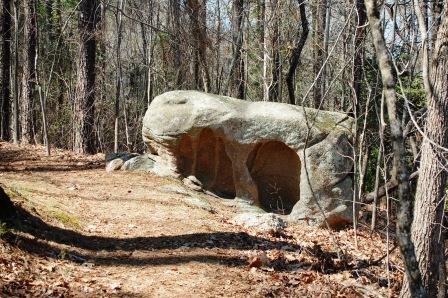
The loop trail in this section consists of several trails. The first, the Rock Trail. As I mentioned, the botanical gardens is located on the Fall Zone and, as at Rocky Mount and Raven Rock State Park, large boulders left behind from erosion are visible throughout the preserve, which increases the challenge of the hikes at times.
Since my geological knowledge is limited to several chapters of Geology of the Carolinas, I cannot begin to explain the slab of land apparently known as the Carolina terrane, which makes up a portion of the eastern section of the Piedmont. If you gotta-have-to-need-to-know, read Chapter 24 of Geology of the Carolinas.
Near the end of the Rock Trail, we reached a small observation deck overlooking a scenic lake. This is a great place to stop, rest, and take pictures.
Honey, you didn't tell me we were having company!
After doing all of the above, we continued on and found a marker for the wildpink, a flower that, according to several sources, grows only along the granite-rich area of the Fall Zone. Since spring was just awakening at the time of our visit, the little darling was still catching up on her beauty sleep. We're planning to return in April in the hopes of catching it in bloom.
But we had more to see, so we strolled along the banks of the lake and crossed the bridge, and there we found the Crane Fly Trail. According to James Fowler's Wild Orchids of South Carolina, the Crane fly blooms from mid-July to mid-August. We spotted one once, in Pisgah National Forest, located in western NC, and had no idea they grew on this side of the state. They do. We found the leaves and seed pods. What a delight it will be to see them at peak.
According to 100 Hikes, in addition to Crane-fly orchids and wildpinks, the preserve is home to a variety of trees, azaleas, and mint. Mint? Not much was blooming during our March visit though, but we did spot some bluets, violets, and phlox.
All this hidden in what others would call the middle of nowhere. The Carolinas do love their secrets.
During this particular hike, I had a chest cold. Roughly three miles of hiking was all I could take, so we missed exploring the Bench Loop and the Children's Bamboo Loop. Next time.
On another note, don't forget to take precautions against ticks when walking in the woods in eastern NC. Though just mid-March, one hitched a ride home with us.
Our thanks to the owners of the De Hart Botanical Gardens for graciously opening the grounds to the public, and allowing us to enjoy the wonders there.
Subscribe to:
Posts (Atom)