During our trip to NC's High Country, we wanted to cram in as many state parks and hikes as we could during our few days there. To help us decide which and where, we brought along Kevin Adams' North Carolina Waterfalls and Best Wildflower Hikes, exploring north carolina's natural areas (not a typo, it isn't capped on the book, either) and North Carolina State Parks, A Niche Guide.
Having spent part of our time at Mt. Mitchell and Linville Falls, we looked for something near Blowing Rock, our headquarters during this trip. With its gables, rocking chairs, and flowers galore (we even spotted one growing in a crack in the sidewalk) Blowing Rock is as charming as it is trendy, so we were surprised to find a hefty little two-plus mile (round trip, longer if you hike beyond the falls) mountain hike within city limits.
I don't recommend this trail for anyone with mobility issues or small children. We had assumed the trail was named in honor of one Glen Burney, but halfway through the hike, we realized Glen was an actual glen, Webster's definition of which is a secluded narrow valley. While the secluded part only applied to the latter part of the trail—we were within city limits, and for a time, spotted houses, manholes in the path, pipes and other manmade features—narrow was right on, and steep at parts, making this a moderate-to-strenuous hike. The falls themselves can be quite dangerous as well, but more on that later.
Down we descended, down rock steps, over narrow portions of the trail, through an explosion of rhododendrons, fighting high humidity that thickened as we descended into the valley, toward not one, but three cascades:
Rhodos everywhere:
Though we took this photo on our way back up the trail, the first waterfall we passed was the Cascades:
Again, we took the following photo on our way back to the trailhead. But this, as with the photos above, shows what we encountered as we hiked down the trail.
Sign for Glen Burney Falls. We splintered off the main trail and descended a bit further into the glen.
Glen Burney Falls isn't tall, but it's attractive on a small scale despite the log:
From there, we continued to Glen Marie Falls, barely visible from a side view:
And situations like this often lead to danger. Kevin Adam includes a strong note of caution about these falls in his Glen Burney Falls entry (pg 81). There are signs at the trailhead and along the trail:
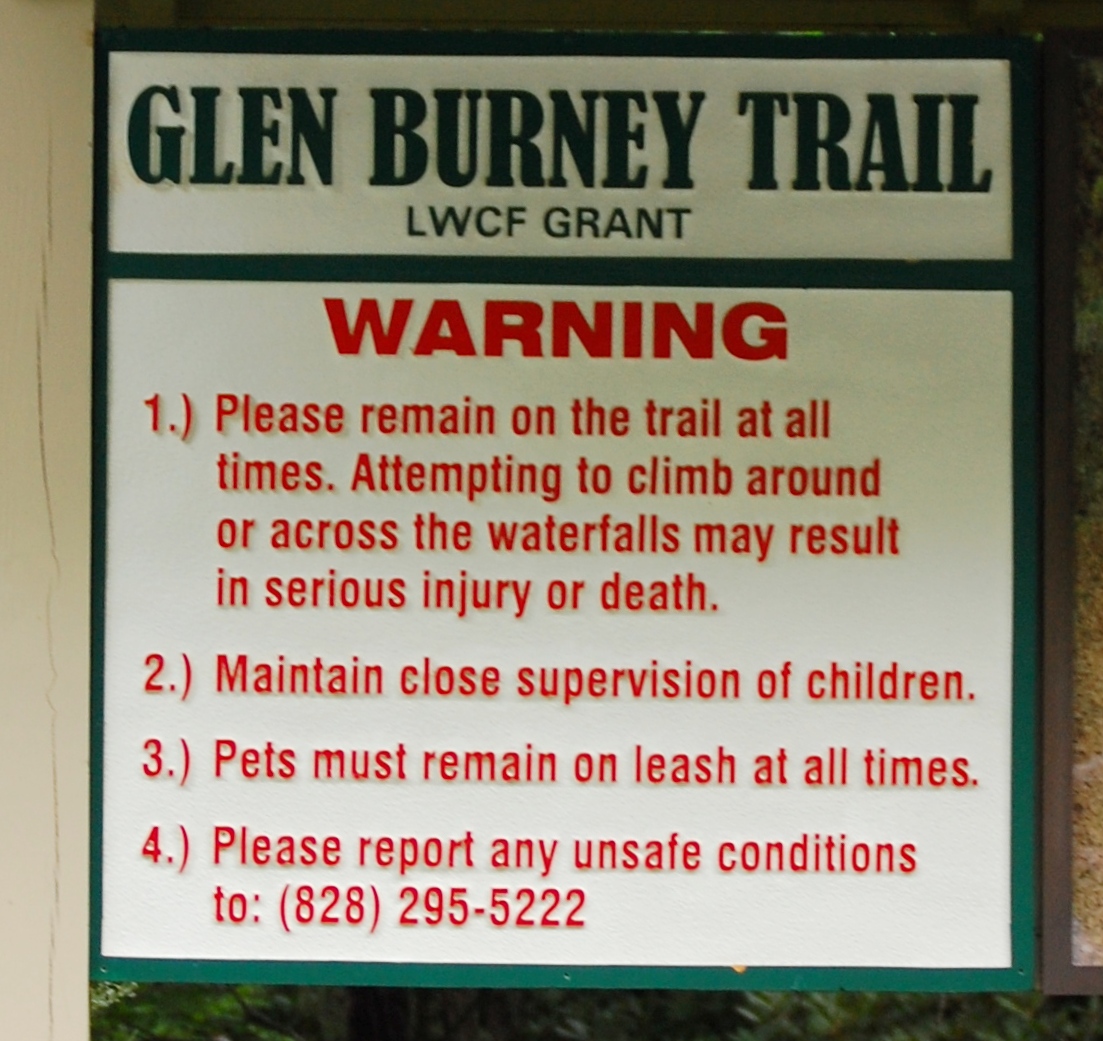
Yet despite these warnings, people are injured because of the very nature of the falls. You noticed how difficult it is to see Glen Marie. Because of that, people are tempted to walk out on the large boulder beside it for a better view. But remember, the water descends into a glen, and those rocks at the falls keep on going—straight down.
The photo above show the continuation of Glen Burney Falls. We couldn't capture the sharp, 75-foot descent onto additional boulders at Glen Marie because of vegetation.
While discussing the trail with a clerk at our hotel, she mentioned a friend of hers had been injured at one of these falls. "I don't the trail is well maintained," she said. I told her it was. The problem lies in the fact people ignore the signs. My husband, moving slow and confidently, did so and took a risk despite the warnings in an effort to take a better photo of Glen Marie. I want to keep him around for years to come, so I moved the camera far from his reach.
So please, if you hike the Glen Burney Trail, stay on the trail and off of rocks. At Glen Marie, stay behind what my husband called the "trip line" (hard to see, and just high enough to trip over).
After taking photos of the final falls and the Rattlesnake Plantain Orchids we found growing nearby, we headed back to the parking lot.
A note on the directions. According to Kevin Adam's book, to reach the trail, turn onto Laurel Lane from Main Street in downtown Blowing Rock, and drive 0.1 mile to the parking area at Annie L. Cannon Memorial Gardens. However, at what appears to be the end of Laurel Lane you'll find both a stop sign and a parking garage. This isn't your destination!
Turn right at the stop sign and then, almost immediately, turn left into the open parking lot at the Gardens.
Across the street and to the left, you should see this:
See? Charming.
After the hike, we intended to visit Mount Jefferson State Natural Area (sometimes referred to as a state park) but the thick humidity we encountered thanks to the unusually high temps that hit the mountains that week zapped our strength. So we hit the showers, and then the stores along Main Street.
For you knitters, they have a yarn shop!
For more information on the falls along the Glen Burney Trails, go to http://www.ncwaterfalls.com/glenburney1.htm
A personal glimpse of towns, mountain trails, state parks, wildlife preserves, and other outdoor destinations in and around the Carolinas. All photos and content copyrighted. Do not use in another blog, website, etc. without permission. (Photo: Pink Sky over Blue Ridge, by Kimberli)
Saturday, July 31, 2010
Wednesday, July 28, 2010
There and Back Again--Again
We're finally home from back-to-back trips. One to Due West, SC for business, and one to Texas on a family matter. I'd forgotten my field guides during the first trip, and didn't have wireless access on the second, so blogging was out for awhile.
Though unable to quench my Carolina curiosity for several weeks, I had a nice dose of home thanks to Bushwackers by William R Trotter. I purchased the book several years ago while living in the SC Upstate and promptly placed it on my Someday Shelf. Before leaving, I blew the dust off the top and started reading about the war of secession in NC's western counties, and found breathtaking description of the Blue Ridge Mountains. Only NC native and poet, Julie Buffaloe-Yoder, could have done a better job, and if you've read Julie's work, you'll know what I mean.
But we're back, and I think North Carolina missed me as well. Upon crossing the border, the mountains treated us to those wispy clouds I so love:
Once the laundry is finished, I'll—finally—finish the Glen Burney Trail report. If you're in or near Blowing Rock and don't mind a mountain hike, you won't want to miss it.
Though unable to quench my Carolina curiosity for several weeks, I had a nice dose of home thanks to Bushwackers by William R Trotter. I purchased the book several years ago while living in the SC Upstate and promptly placed it on my Someday Shelf. Before leaving, I blew the dust off the top and started reading about the war of secession in NC's western counties, and found breathtaking description of the Blue Ridge Mountains. Only NC native and poet, Julie Buffaloe-Yoder, could have done a better job, and if you've read Julie's work, you'll know what I mean.
But we're back, and I think North Carolina missed me as well. Upon crossing the border, the mountains treated us to those wispy clouds I so love:
Once the laundry is finished, I'll—finally—finish the Glen Burney Trail report. If you're in or near Blowing Rock and don't mind a mountain hike, you won't want to miss it.
Saturday, July 03, 2010
Linville Falls
Our first stop of the day took us to Mt. Mitchell, the highest point in the east. The second, the deepest gorge in the east. And they're approximately forty-three miles apart along the Blue Ridge Parkway.
I've heard and read much about Linville Gorge and Falls. Members of my hiking group have ventured into the gorge and returned with exciting stories of strenuous hikes and photos of a vast, rugged wilderness—and, on occasion, an isolated field of daffodils. I shied away from the idea of navigating craggy rocks and steep cliffs but was equally curious about those formations, so different from the surrounding landscape. It's one of the reasons I purchased Exploring the Geology of the Carolinas (Steward and Robertson, UNC Press.) From the chapter on Linville Gorge, I learned the rocks in and around the falls are a spectacular example of a "tectonic window". A cross-section of a significant geologic event. No digging required!
More on that in a minute. As it turns out, there are several short (in hiker terms) stops along a trail that allow visitors to view Linville Falls from three different perspectives: eye level, high, and much higher. The trail difficulty is easy, difficult and tiring. After parking and making a short trip to the Visitors Center, we crossed a bridge. Following signs, we arrived at the first overview in just a few minutes.
Notice the rock in the photo above, and at the "observation" platform:
From here, the river glides through a small gorge carved by the current, much like water flows down a slide at a water park:
Then, the river twists and turns, and spills over yet another small cliff. We hiked along the Erwins View Trail to the Chimney View overlook, where both falls were visible:
Along with a different type of rock. See the difference?
We continued on up the trail to the Gorge View Overlook, which tested my fear of heights:
And then to the Erwins View Overlook, where I nearly ran back down the trail when a young man decided he had to take photos from the stone wall.
Please don't do that. There is an unobstructed view of the falls from the safer, far side of the overlook:
From there, we hiked back to the parking lot and the bottles of water we'd forgotten to bring along. Back at the hotel, I picked up Exploring the Geology of the Carolinas, and reviewed the chapter on Linville Falls. Had I read it in advance, I would have remembered the folded (melted looking) rock around the falls is actually older than the rock around the lower falls (photos 7 and 8). This is the result of a collision between plates.
Yes, that's right. We were looking at a fault! The authors of Exploring do a good job explaining the collision, the resulting thrust fault and the "shear zone" now visible. I highly recommend this book to those interested in the geology of the Carolinas. For more information on the Linville Fault, read the technically oriented http://web.me.com/carogeosoc/CGS/1990s_files/gb%201997.pdf or, in relation, www.unc.edu/~kgstewar/downloads/Burnsville.pdf
And for more information on Linville Falls, click on the following links:
www.cs.unca.edu/nfsnc/recreation/wncwaterfalls/linvillefalls.htm
www.nps.gov/blri/planyourvisit/upload/Linville%20Falls%20Trails.pdf
Time well spent along the Blue Ridge Parkway.
I've heard and read much about Linville Gorge and Falls. Members of my hiking group have ventured into the gorge and returned with exciting stories of strenuous hikes and photos of a vast, rugged wilderness—and, on occasion, an isolated field of daffodils. I shied away from the idea of navigating craggy rocks and steep cliffs but was equally curious about those formations, so different from the surrounding landscape. It's one of the reasons I purchased Exploring the Geology of the Carolinas (Steward and Robertson, UNC Press.) From the chapter on Linville Gorge, I learned the rocks in and around the falls are a spectacular example of a "tectonic window". A cross-section of a significant geologic event. No digging required!
More on that in a minute. As it turns out, there are several short (in hiker terms) stops along a trail that allow visitors to view Linville Falls from three different perspectives: eye level, high, and much higher. The trail difficulty is easy, difficult and tiring. After parking and making a short trip to the Visitors Center, we crossed a bridge. Following signs, we arrived at the first overview in just a few minutes.
Notice the rock in the photo above, and at the "observation" platform:
From here, the river glides through a small gorge carved by the current, much like water flows down a slide at a water park:
Then, the river twists and turns, and spills over yet another small cliff. We hiked along the Erwins View Trail to the Chimney View overlook, where both falls were visible:
Along with a different type of rock. See the difference?
We continued on up the trail to the Gorge View Overlook, which tested my fear of heights:
And then to the Erwins View Overlook, where I nearly ran back down the trail when a young man decided he had to take photos from the stone wall.
Please don't do that. There is an unobstructed view of the falls from the safer, far side of the overlook:
From there, we hiked back to the parking lot and the bottles of water we'd forgotten to bring along. Back at the hotel, I picked up Exploring the Geology of the Carolinas, and reviewed the chapter on Linville Falls. Had I read it in advance, I would have remembered the folded (melted looking) rock around the falls is actually older than the rock around the lower falls (photos 7 and 8). This is the result of a collision between plates.
Yes, that's right. We were looking at a fault! The authors of Exploring do a good job explaining the collision, the resulting thrust fault and the "shear zone" now visible. I highly recommend this book to those interested in the geology of the Carolinas. For more information on the Linville Fault, read the technically oriented http://web.me.com/carogeosoc/CGS/1990s_files/gb%201997.pdf or, in relation, www.unc.edu/~kgstewar/downloads/Burnsville.pdf
And for more information on Linville Falls, click on the following links:
www.cs.unca.edu/nfsnc/recreation/wncwaterfalls/linvillefalls.htm
www.nps.gov/blri/planyourvisit/upload/Linville%20Falls%20Trails.pdf
Time well spent along the Blue Ridge Parkway.
Subscribe to:
Posts (Atom)