I don't often blog about Carolina destinations we missed during an excursion, but since I hoped to provide a good overview of the ACE Basin, I can't put off these locations until later.
Edisto Beach
Located on the southern tip of Edisto Island, Edisto Beach, is, as their website says, "one of the few uncommercialized, family-oriented beaches left." During all-to-brief visits in past years, we spotted few restaurants and hotels. Lodging is in the form of rentals: condos, townhomes, and beach homes. The tourist for the island, not the island for the tourist.
So why go? It's beautiful, isolated, and it's the home of....
Edisto Beach State Park
Our goal is to rent one of the cabins at Edisto Beach State Park and explore the trails by foot or bike, spend hours on the beach, and search the shore for sharks teeth.
Colleton State Park
Just north of Walterboro, Colleton State Park offers a nature trail, picnic grounds, ballpark, and, according to the SC Park's website, ideal paddling opportunities. See their website for more information.
Givhans Ferry State Park
According to the SC Park's website, Givhans Ferry "boasts a well-regarded mountain bike trail, shady campgrounds and well-kept, rustic cabins that offer a peaceful stay in the rural Lowcountry woods...The park is part of the 56-mile long Edisto River Canoe and Kayak Trail, and is at the end of a popular 21-mile downstream paddle from Colleton State Park. Givhans Ferry State Park is also known for its limestone river bluff and sinkholes."
See their website for more information.
Old Sheldon Church Ruins
Though it suffered damage during the Revolutionary War and the War Between the States, the hauntingly beautiful remains of Sheldon Church still stand near Yemassee. Click here to see photos and to read about the church's tragic history.
We traveled to the ACE Basin to learn more about the area. While I walked away without knowledge of its estuaries and vital importance, I did learn the Basin has much to offer in terms of outdoor activities. I hope to spend more time there in the future.

A personal glimpse of outdoor destinations in and around the Carolinas. All photos and content copyrighted.
Snow!
Last week, snow fell in forty-nine American states. Portions of eastern North Carolina received anywhere from one-to-four inches or more. The second such storm in a month, the winter event quickly became the subject of Tweets, blog posts, and Facebook statuses, and it seemed everyone took pictures. Thanks to Twitter and FB, I saw photos of snowy landscapes from the Blue Ridge Mountains to the Outer Banks, and down to South Carolina's Lowcounty. Of course, I took a few as well. Why waste a chance to practice photography?


Birds left more than empty shells near a bird feeder:

The "blizzard" shut down the local state park.

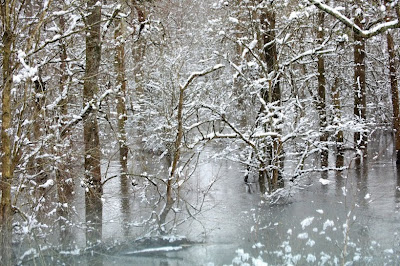
Rivers and black-water swamps decked out in white.

But some didn't seem to appreciate the finery.


I may need more practice taking pictures under such extreme lighting conditions, but hopefully, opportunity will wait a year. I enjoyed the snow, but I'm looking forward to the sight of wildflowers covering fields and roadsides, and taking long walks through Carolina woods.


Birds left more than empty shells near a bird feeder:

The "blizzard" shut down the local state park.

Rivers and black-water swamps decked out in white.


But some didn't seem to appreciate the finery.


I may need more practice taking pictures under such extreme lighting conditions, but hopefully, opportunity will wait a year. I enjoyed the snow, but I'm looking forward to the sight of wildflowers covering fields and roadsides, and taking long walks through Carolina woods.
ACE Basin National Wildlife Refuge
We enjoyed our trips to Hunting Island State Park and Beaufort, but we had much to learn on this adventure, and I hoped to do that at the ACE National Wildlife Refuge.
 Unfortunately, the day after we arrived in the Lowcountry, the sky burst open and a deluge drenched an already soaked land. Several low-lying areas around the Carolinas were either under a flood watch, or experienced flooding. Consequently, when we arrived at the refuge's Visitors Center, we encountered locked doors (apparently, they weren't expecting visitors on a cold rainy day in January. Clearly, they don't know us.) We also noticed deep mud puddles dotting the dirt roads. Without the Durango, we didn't have the clearance or the four-wheel drive necessary to tackle that hurdle.
Not that it helped us in the past...
I wish I could have walked inside the Visitors Center. From preliminary research on the Basin, I learned a South Carolina treasure is hidden in the heart of the refuge, and the pictures didn't prepare me for the sight of a historic plantation house surrounded by enormous moss-laced oak trees.


I love old plantations. Not for the tragic history they often represent, but because of the architectural wonders they usually are, and Grove Plantation House is a beauty. Surrounded by dozens of those majestic oak trees, it's one of those sights you need to see in person to appreciate. European ownership of this area dates back to the days of, or just after, the Lord's Proprietors. The land was originally granted in 1694. However, according to the refuge's website, the house was built in 1828.
I also had to get inside to get my hands on much needed brochures. Detailed information on the refuge is hard to find. It's mentioned in Coastal South Carolina, but I learned little more than wildlife, including numerous endangered species, live within its 11,000 acres.
 Unable to glean facts from a field trip, I had to turn to the Internet. The primary sources I found (aka, the refuge's website!) indicate the refuge is a great place for birding, hunting and fishing (see website for information, restrictions and any applicable fees). A trail map shows numerous paths suitable for touring the refuge on foot, several of which skirt ponds.
NOTE: Summer and early autumn are NOT the time to go hiking through Lowcountry woods, thanks to ticks and mosquitoes. Without personally checking it out, I can only assume the best times to visit are spring and late fall, and in the winter on a clear day.
The ACE Basin National Wildlife Refuge consists of two units, the Edisto Unit, which is located near Adam's Run, and the Combehee Unit, located off River Road near its intersection with Hwy 17A. For more information, including directions, check out the following websites:
www.fws.gov/acebasin/
www.fws.gov/southeast/pubs/acebasin_gen.pdf

-------------------
Copyright 2010. Do not use or distribute text or photos.

Not that it helped us in the past...
I wish I could have walked inside the Visitors Center. From preliminary research on the Basin, I learned a South Carolina treasure is hidden in the heart of the refuge, and the pictures didn't prepare me for the sight of a historic plantation house surrounded by enormous moss-laced oak trees.


I love old plantations. Not for the tragic history they often represent, but because of the architectural wonders they usually are, and Grove Plantation House is a beauty. Surrounded by dozens of those majestic oak trees, it's one of those sights you need to see in person to appreciate. European ownership of this area dates back to the days of, or just after, the Lord's Proprietors. The land was originally granted in 1694. However, according to the refuge's website, the house was built in 1828.
I also had to get inside to get my hands on much needed brochures. Detailed information on the refuge is hard to find. It's mentioned in Coastal South Carolina, but I learned little more than wildlife, including numerous endangered species, live within its 11,000 acres.

NOTE: Summer and early autumn are NOT the time to go hiking through Lowcountry woods, thanks to ticks and mosquitoes. Without personally checking it out, I can only assume the best times to visit are spring and late fall, and in the winter on a clear day.
The ACE Basin National Wildlife Refuge consists of two units, the Edisto Unit, which is located near Adam's Run, and the Combehee Unit, located off River Road near its intersection with Hwy 17A. For more information, including directions, check out the following websites:
www.fws.gov/acebasin/
www.fws.gov/southeast/pubs/acebasin_gen.pdf

-------------------
Copyright 2010. Do not use or distribute text or photos.
Beaufort, South Carolina
New Bern, Murrells Inlet, Charleston, Greenville (SC), and the Blue Ridge Parkway are a few of our favorite Carolina destinations. We visit when we can, to explore and to soak up the beauty that makes each of those places unique. But when I need a hideaway, a place to decompress after a conference or a long stretch without a vacation, we head off the beaten track to the unassuming coastal town of Beaufort, South Carolina.
Resting on a curve of a river by the same name, Beaufort (pronounced "Bu-ford" in SC, according to the nice police officer who didn't arrest me for playfully slapping my husband after he said "I told you so") is somewhat centered in a cluster of sea islands situated between Charleston and Savannah. Within that cluster, Parris Island sits to the southwest, and Hunting Island, the southeast. While not technically within the ACE Basin's boundaries, Beaufort was a must stop on our ACE tour.
Why?
 With fat palm trees, tendrils of moss hanging from old oaks, tidal creeks visible from various streets, hotels and restaurants, shops, a charming downtown lined with attractive stores and homes, carriage rides, and boats lounging in the harbor near the waterfront park off Bay Street, Beaufort is an exotic getaway with the creature comforts of home. And my word, you should see the place in spring. Pink, red and white azaleas compete with an abundance of tulip magnolias that bloom throughout the city. It's breathtaking.
It isn't bad during the rest of the year, either:
Though we've visited Beaufort several times, we've yet to explore the winding backwaters of the Lowcountry. When I tweeted our intentions to visit the city, a fellow Twitterer recommended kayaking. Lack of time and the heavy rain that fell shortly after our arrival dashed that hope. Next time.
Conveniently located near the ACE Basin, Hunting Island, and Parris Island, Beaufort is less than an hour from Hilton Head, and about one hour from Savannah, GA. For more information on Beaufort, including a bit about their history, go to www.beaufortsc.org/ and www.beaufort-sc.com/history/
Resting on a curve of a river by the same name, Beaufort (pronounced "Bu-ford" in SC, according to the nice police officer who didn't arrest me for playfully slapping my husband after he said "I told you so") is somewhat centered in a cluster of sea islands situated between Charleston and Savannah. Within that cluster, Parris Island sits to the southwest, and Hunting Island, the southeast. While not technically within the ACE Basin's boundaries, Beaufort was a must stop on our ACE tour.
Why?

It isn't bad during the rest of the year, either:
Though we've visited Beaufort several times, we've yet to explore the winding backwaters of the Lowcountry. When I tweeted our intentions to visit the city, a fellow Twitterer recommended kayaking. Lack of time and the heavy rain that fell shortly after our arrival dashed that hope. Next time.
Conveniently located near the ACE Basin, Hunting Island, and Parris Island, Beaufort is less than an hour from Hilton Head, and about one hour from Savannah, GA. For more information on Beaufort, including a bit about their history, go to www.beaufortsc.org/ and www.beaufort-sc.com/history/
Subscribe to:
Posts (Atom)